
Back
Press Release
Speech: David Seymour at the Canterbury Club
Innovation trials; a pathway through bureaucracy

David Seymour
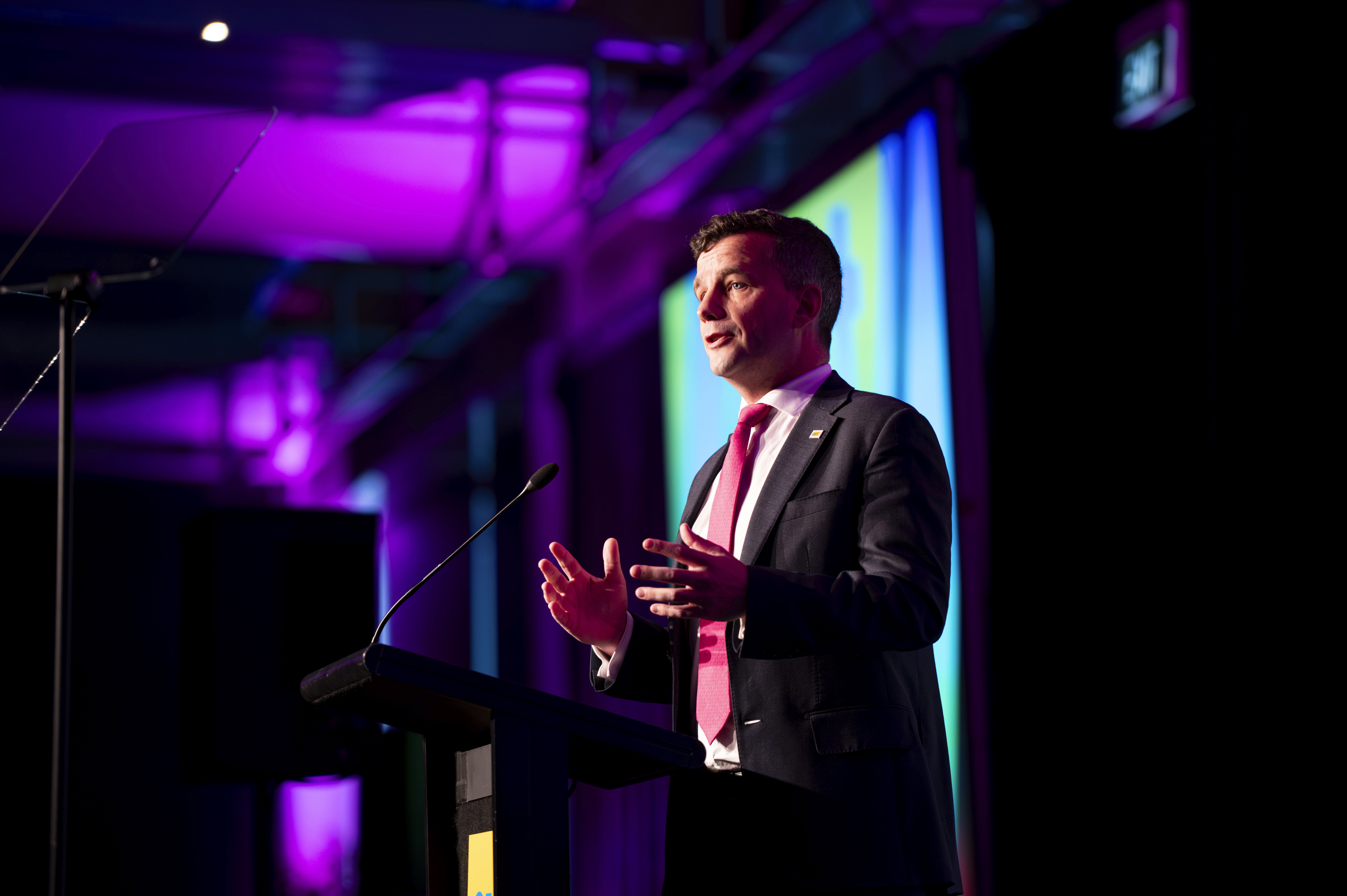
David Seymour, ACT Leader
To the Canterbury Club: 129 Cambridge Terrace, Christchurch
Thursday 16 July, 12:30pm
Innovation trials; a pathway through bureaucracy
Introduction
Thank you for coming out to hear a politician on a Thursday afternoon. I’m absolutely positive you had better options, you live in Christchurch after all, so you being here means a lot.
The world feels uneasy at the moment, for lots of reasons you already know, but Christchurch carries a glimmer of hope. Hope for the kind of innovative country New Zealand could be.
We need to be using the best and latest technology, because it is technology and innovation that ultimately drive wages. Getting closer to the technology frontier is essential for a prosperous future in New Zealand. The aim of creating a billion-dollar tech sector here is exactly the kind of aspiration this country needs.
Christchurch is a snapshot of that goal. The city is an example of the values of risk-taking, resilience and innovation. From the rebuild after the earthquakes, to the latest software and agritech start-ups, and New Zealand’s first fully enclosed multi-use stadium.
I want to feel the same pride about New Zealand that Cantabrians feel about their city.
When I watch shows like Clarkson’s Farm in the UK, and see Jeremy Clarkson using agricultural drones to map field boundaries, identify problem areas in crop health and spray crops, I wonder, why is this technology illegal in New Zealand?
When I see people in America hopping into driverless cars, I think how cool is that? But in New Zealand they’re also illegal.
What makes these sorts of things good enough for the countries we aspire to be like, but not good enough for us?
The Need for Productivity
Overseas, everywhere you look, you see technology changing lives for the better. Whether it’s autonomous vehicles driving through Texas, drones dropping off Amazon orders and tending to crops, or miraculous breakthroughs in medical technologies.
It begs the question – if people in the United States, Japan, the United Kingdom and Europe have access to these new technologies and inventions – why aren’t they in New Zealand?
Are we making the most of this new age of innovation?
Unfortunately, I think the answer is no. Increasingly, I fear we are slipping away from the frontier of innovation. A core driver of that is a sluggish and slow system of government that struggles to keep pace with change.
In my State of the Nation speech this year, I identified five warning lights flashing on New Zealand’s dashboard:
An ongoing productivity slump leading to lower wages and a sagging economy
The Government’s need to balance its books
The growing distrust of democracy
Losing a shared national identity
An intergenerational divide, with young people losing faith and going abroad
This speech is about the first of these warning lights – the urgent need to get a defibrillator on our flatlining productivity. And, as I said, Christchurch values point to how an economic resuscitation could happen.
Here in Christchurch people get it when I talk about the burden of red tape on productive activity. I meet innovative firms facing higher compliance costs, painful health and safety rules, and drawn-out consenting processes that hold back growth.
The Dead Hand of Overregulation
There’s an irony in Government strangling business with red tape. Government needs business far more than business needs Government. If business stopped tomorrow there would be no wages, no company tax, no GST, no excise tax. Government would die instantly without the revenue that business provides, but business could replace most of what Government does and do it better.
Government self-sabotages by restricting those seeking to innovate, to create the very wealth that sustains it. This is an existential threat. It is the greatest blockage in the system that holds New Zealand back from achieving its full potential.
My conversations with Uber summed this up perfectly. They said if they brought their driverless cars to New Zealand, they wouldn’t be trialling their technology, they would be trialling the New Zealand Government.
I came to politics for the opposite reason to most other politicians. My mission is to reduce the power of Government. I figured at least one person should make it their mission to get the government out of productive people’s way.
This year you will see plenty of politicians who say more laws against businesses and wealthy people will somehow make the whole country richer. We must resist that shortcut.
But you won’t hear that from ACT. As I say, we tread the narrow path of seeking power so we can give it back.
ACT doesn’t say politicians have the answers. In fact, we say politicians don’t have the answers!
We say instead that the role of politicians is to create the environment where people are free to create and provide the solutions and services they see a need for.
I’m talking about the passionate entrepreneur who rebuilt after the earthquakes and turned a local idea into a thriving business. The restaurateur who spotted a gap in the market and grew a local favourite into a great success story. The mother who started a daycare service because she saw a need in her community for good childcare.
These are just three of many sectors where innovation is stifled by regulation, and three sectors where ACT has driven real change in this government based on what we’ve heard from people like you.
And it’s only through the grit and imagination of people like these, that New Zealand can fall on the right side of the economic knife edge we’re now on.
We truly are at an economic tipping point. Everyone I talk to can feel it. More than ever before we need the sparks of economic activity that can grow into a blaze.
The Deregulation Agenda
This is exactly the reason why it was so important to me this term that the Government create a Ministry for Regulation. Perhaps it could be called the Ministry for Deregulation.
This was the vehicle for my political mission to make life simpler, to get the government out of people’s way, bring down costs, drive innovation and unleash the economy.
There is an unbelievable number of regulatory agencies, over 260. Now, there is one agency standing up for your right not to be regulated.
We saw in America Elon Musk come in with DOGE, on a very similar mission. Even with the full weight of American presidential power and some outstanding brains behind them, DOGE didn’t deliver the 30% reduction in expenditure that was promised. The tangled thorns of regulatory bureaucracy are not easily pruned. I can empathise with this!
And I’m proud of the Ministry for Regulation. There have been some great successes. We’re letting Kiwis build garden sheds without consent, we’ve taken a red pen to burdensome ECE rules, we’ve exempted home cake bakers from registration, food plans and audits, and we’re letting farmers access more agricultural products faster. We’ve made it easier to grow hemp and export medical marijuana. We’ve totally deregulated hairdressers, made it easier to execute a Will, and so it goes on. Economists say we’ve added ~$10 in value for every $1 we’ve spent. That’s not bad.
But how do we make this bigger, faster and stronger? MfR has 90 employees, compared to 60,000 across the public sector. This is a real David and Goliath situation – almost literally. Perhaps David and Leviathan would be more accurate.
So we step back and ask – what is at the root of the problem? How can we allow the economic blaze of innovation to catch on?
For all the criticism they get, the public sector is not malicious. Most try to implement the Government’s mandate to enable innovation and let businesses get on with it. But there’s a big obstacle here.
Anxiety. And it’s contagious.
A Minister will make a common sense request – “I want to let home cake bakers sell food by default, and no longer have to spend thousands of dollars getting audited.”
Then, the Ministry goes away for a month and thinks. Eventually, they come back with a 20-page report that says, “Minister, we couldn’t possibly do that, lethal bacteria can grow on flour and if we don’t regulate bakers people might die.”
Here's a simple decision point that politicians all over the world face every day. It's much less scary to say "ok, keep the regulation then. I don't want to be responsible for people dying."
But ask the common sense questions. People make and eat homemade cakes every day - nobody is dying. The risk from flour isn't zero, but it has never needed a government audit to manage. People have been baking safely for centuries without a Ministry signing off on it. And here's the clincher: if eating home-baked goods were genuinely dangerous, a compliance audit that checks a box once a year wouldn't stop it. The regulation isn't actually protecting anyone. It's creating the feeling of protection - while adding real cost to real people.
That's the trap. The anxiety is real. The protection is illusory.
So we need a solution to that anxiety. Currently we see agencies spend years writing new regulations, years consulting on them, even more time worrying about what could go wrong.
So we are slow and we aren’t improving outcomes.
The Promise of Innovation Trials
I think we may have found the solution. They’re often called “Regulatory sandboxes,” but that sounds off, so I prefer “Innovation Trials”.
They are time-limited trials where certain regulations are suspended, or where new regulatory settings are tested.
And when the inevitable concerns spring up, “but what happens if something goes wrong?!”
The answer is that it is just a time-limited trial, and if things do go wrong it doesn’t need to continue. Minds are put at ease, the sky isn’t falling.
In effect, we would empower a Government Minister to strike down specific regulations for a specific amount of time. If, say, someone wanted to do a trial of driverless cars in Christchurch, they could go to the Government and it could grant a sandbox where specific rules were set aside for a specific period in a specific region.
Right now, Innovation Trials are a tool we reach for occasionally. The Ministry for Regulation has now created a blueprint for how we could turn to them as the default. I want New Zealand to be the country that other countries look at and say - if you want to try something new, go there first.
For the first time we have a Ministry for Regulation which can look over regulators’ shoulders and say, “hey, why don’t you use this exemption clause to deploy innovation trials,” then show them exactly how to do it.
As a central agency, one of the Ministry for Regulation’s roles is to coach and upskill other ministries, increasing the effectiveness of all regulators. This policy is regulatory improvement in action.
Our work on agricultural drones is an example of exactly why this arm of the Ministry for Regulation’s functions is so important.
Many of you will have watched Clarkson's Farm this year. In Series 5, Jeremy Clarkson travels to the Netherlands to watch a farmer spray his crops with an agricultural drone. Precise, targeted application of chemicals at a fraction of the cost of using machinery used by farmers in New Zealand.
That drone cannot be used on a New Zealand farm today. Not because it's dangerous, but because it weighs more than 25 kilograms. Under our current aviation rules, anything above that threshold requires a Part 102 certification, a process that costs up to $2,000 and takes more than 12 months. In Australia, drones up to 150 kilograms operate on farmland under simple licensing. We're not talking about a cutting-edge technology New Zealand can't access. We're talking about something our competitors are already using, every day, on farms not far from here.
The tyranny of the regulatory check box is creating a risk to our most productive industry.
And the demand for this is already here in New Zealand. The number of large agricultural spray drones in New Zealand doubled last year, from 80 to 160. The only thing in the way of more productivity is pointless rules.
The Ministry for Regulation identified agricultural drones as a perfect candidate for an Innovation Trial. We said: suspend the weight limit for a defined period on defined farmland, collect the data, and if nothing goes wrong, make it the new norm. The Civil Aviation Authority's response? They've added it to a two-year work programme.
And remember, European and British farmers compete with Kiwi farmers. In two years there will almost certainly be new technology which puts Kiwi farmers even further behind the 8-ball.
Two years. For something we already know works, that our competitors already do, that our own officials agree poses manageable risks. That is exactly the gap this framework is designed to close.
This is an illustration of the wider problem. We want to grow our economy, attract more high-paying jobs, and raise productivity. But we force Kiwi businesses to operate well behind the frontier of technology which will move them towards these goals.
If we began utilising innovation trials at scale, think about what we could achieve, what we could actively go out and recruit.
Autonomous vehicle companies are burning through billions of dollars trying to find the right regulatory environment to test their technology at scale. Most jurisdictions are slow, overly cautious, and unpredictable.
We could offer them something no other country could: a clear framework, a guaranteed timeline, and a government that will get out of the way and let them prove what their technology can do. We need to stop hoping they choose New Zealand, and go and get them.
The Ministry for Regulation has already done the work. We know what the current barriers are. Now we need the Government to prioritise it.
The same logic applies to medical innovation. Clinical trials that take years to approve in the United States or Europe could happen here in months, under a contained Innovation Trial, with proper evaluation and protections built in.
We could be attracting world-leading medical researchers to run their trials on New Zealand soil. Kiwis would benefit from the best-in-class emerging treatments. It would bring jobs, investment, and breakthroughs that benefit New Zealanders first.
Another example of where this approach could have helped is the work to establish a pathway for prescribing psilocybin to patients with treatment-resistant depression. To make that possible under existing law, Medsafe had to work through complex legislation, identify the appropriate legal mechanism, and develop an entirely new prescribing pathway for an authorised psychiatrist.
Rather than each agency having to develop bespoke solutions from scratch, agencies could draw on shared expertise to identify existing legislative powers, exemptions and regulatory pathways more quickly. That could save officials, Ministers and clinicians time, while helping New Zealanders gain access to safe and innovative treatments sooner.
And the list goes on. Crypto and digital finance. AI applications. Precision agriculture. Cell-cultivated food.
These are industries worth billions. They’re all looking for somewhere to land. Right now they look at New Zealand and see the same slow regulatory machinery they're trying to escape. We could be the place they’re all looking for.
The countries winning this race to attract new tech aren't waiting. Singapore actively recruits companies into its regulatory sandbox programme. The UK's Financial Conduct Authority has accepted 191 firms through its sandbox since 2015. These governments made a decision: uncertainty is the enemy of investment, and we will reduce it faster than anyone else.
That's the campaign I want to run. Not just removing barriers when they're pointed out to us. Going out into the world, finding the industries that are being held back by slow and risk-averse governments, and saying: New Zealand is open. Bring your idea here. We'll build the runway while you're still designing the plane.
ACT's commitment is this: we will make Innovation Trials a standing offer: not a favour a Minister grants when someone complains loudly enough, but a published, permanent pathway that any company, anywhere in the world, can apply to. A front door for innovation, not a back door.
Conclusion
New Zealand punches above its weight when we back ourselves. RocketLab didn't happen because we waited. It happened because we built the legal framework and said come here, do this, we'll make it work. Halter didn't put necklaces on a billion dollars' worth of cows by accident — someone had an idea, backed it, and New Zealand let them run.
The question is whether we do that once in a generation, or whether we make it who we are.
ACT says we make it who we are.
ENDS