
Back
Press Release
Speech: David Seymour at Graeme Dingle Foundation Business Leaders’ Dinner
How to save childhood without destroying adult freedom

David Seymour
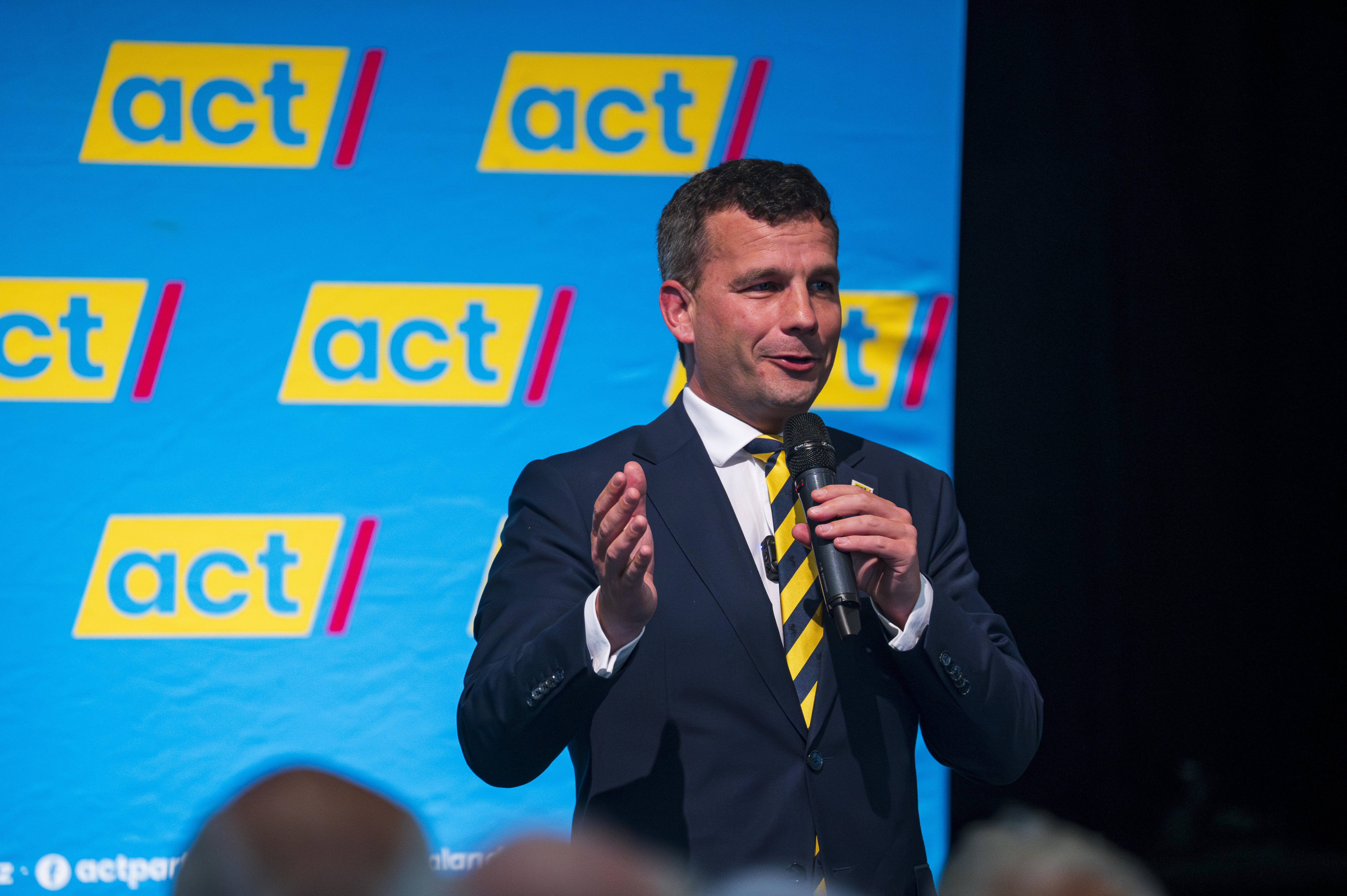
David Seymour
MP for Epsom, ACT Leader, Deputy Prime Minister
Speech to Graeme Dingle Foundation Business Leaders’ Dinner
Wednesday 15 July, 2026
How to save childhood without destroying adult freedom
Introduction
Thank you very much for hosting me tonight. I can’t tell you how much I admire what Sir Graham and Lady Jo-anne have built since that meeting on the mountain.
Real kindness is putting your hand in your own pocket, so thank you to everyone who’s come together tonight to support the Foundation’s visionary work.
In writing a speech for tonight I faced a dilemma. Giving you a political broadcast would be crass, but what else can a politician do?
I settled on a topic that is highly relevant to the Foundation’s work, politically contentious, and where I think I can inject a new idea.
I want to start with your vision here at the Graeme Dingle Foundation, because it is a very good one: that New Zealand will be the best place in the world to be young.
Something most people would agree is a worthy goal.
But what if instead of comparing ourselves to the rest of the world we ask:
Is life better for Kiwi kids today? Or did my generation, for example, have better childhoods?
Would you rather be a kid in the 90s? Or today?
Has life got better for our kids or worse?
Call me a nostalgic millennial, but unfortunately, I think we may be going backwards.
The Scourge of Social Media
There are lots of reasons for this, but the one we all find ourselves talking about these days is social media.
Tonight I’d like to argue that children don’t face a problem with social media problem, but with smartphones.
Some people say, “Well, every generation panics about new technology.”
Television was going to rot our brains and give us square eyes.
Video games were going to create violent psychopaths.
And now apparently TikTok is destroying civilisation one dance trend at a time.
Adults are capable of turning our own confusion about young people into moral panics. I’ve seen quotes from Roman times criticising the young for being indolent ingrates.
But here’s the thing. Even if you take a sceptical view of the concerns about social media and children, it is very difficult to say social media is making childhood better.
The Kids aren’t alright
As a government we have been grappling with this.
We have now had more than 15 years of social media use.
And if you look at the timing, scale, and the consistency across developed countries, it is very hard to avoid the conclusion that something fundamental changed when children began carrying smartphones everywhere and living large parts of their lives through social media.
Anxiety, depression, self-harm, poor body image, loneliness, and declining life satisfaction.
Take the New Zealand Health survey. In the pre-smartphone era, 15 years ago, around five percent of 15-24 year olds reported high or very high mental distress. Now that figure is nearly five times higher, around 23 per cent.
Even that masks the true size of the problem. For females that figure is 29 per cent, versus 16 for males in that age bracket.
There are social effects too.
More polarisation, division, and kids feeling that every political disagreement is a moral existential crisis.
This again appears to hit harder for female users than male, but I don’t know enough about gender and group psychology to say why.
What is clear is that the incentives of social media companies are simply not aligned with the wellbeing of children.
They do not make more money when a 12 year old goes outside, climbs a tree, and forgets the internet exists for a few hours.
There is no advertising revenue in tree climbing.
They employ extremely smart people to figure out how to keep that child looking at the screen.
Kids are not merely social media users. They are the product.
The Role of Government in Social Media
Now, my usual instinct is that government should get out of the way.
There is also a very strong argument that parents should take responsibility for protecting their kids.
Believe me, if you think Government doing something is a good idea, I can change your mind with a few hours in Wellington.
That doesn’t make me an anarchist. Sometimes Government intervention makes sense. Take our fishing rules.
The Quota Management System is a triumph. Despite the grumbles from fishers, stocks have recovered dramatically since the 1980s.
The problem was a coordination problem. If you can’t trust the other guy not to catch all the fish, you might as well get in first.
Guess what? Everyone else is making the same calculation, and the end result is no fish.
So, the Government made a rule and now we’re all in a much better place.
I would argue there is a similar problem with parents trying to control their children’s social media access.
Most parents do not want their child to spend six hours a day on social media.
But they also do not want their child to be the odd one out.
They want to take action, but the burden of acting alone feels too hard.
This is the sort of situation where the government can play a role.
The Fools’ Errand of a Social Media Ban
But social media bans are very hard to implement and some of the solutions currently being proposed are worse than the problem they are trying to fix!
Last week there was talk of banning VPNs!
Universal age verification would mean every one of us has to hand over ID and data to access any social media site.
These are not just wrinkles in the policy. They expose a fundamental problem. Motivated teenagers are generally better at using technology than their parents.
Any system strong enough to stop a motivated teenager will be strong enough to take the internet privacy and freedom of an adult.
A social media ban could also alienate children from adults. If they know that what they are doing is forbidden, they may be less likely to reach out when something goes wrong.
And nobody seems capable of clearly defining what should be banned anyway.
Is YouTube social media? WhatsApp? Discord? Reddit? Gaming platforms with chat functions?
The moment you draw the line, technology changes and makes the line obsolete.
We don’t want young people migrating to worse parts of the internet either.
Push them away from the mainstream sites and they could end up in darker and less accountable online spaces.
But maybe protecting kids from the harm of social media doesn’t need to be as complicated as we are making it.
Perhaps we just aren’t looking at this from the right direction.
A new idea for addressing social media harm
Political writer Ani O’Brien suggests that instead of trying to regulate every social media platform perhaps we should focus on the device that gives them constant access to all of it.
Put simply, why don’t we deal with the hardware instead of the software?
Ani says: “We have become strangely accustomed to the idea that every child should carry around what is effectively the most sophisticated communications device ever invented, complete with unrestricted internet access, a high-definition camera, GPS tracking, infinite entertainment, and an endless stream of algorithmically curated content available every waking moment.”
We give children these extraordinarily powerful machines, then agonise about how stop them using it for the very things it was designed to do.
Now it is handy for kids to have phones so they can call home, contact emergency services, and text their friends to organise hanging out.
But do they need smartphones?
There are a few ways Government could support get smartphones out of kids’ hands.
We could issue clear guidance. Recommend phones suitable for children. Schools, youth organisations and parents could work from shared advice.
That would help solve parents’ coordination problem. They could say, ‘I’ve talked to your friends’ parents, none of you are getting a smartphone but here is the list of what’s deemed safe.
A ban on supplying Smartphones to Under-16s
Or, the Government could go further.
We already prohibit adults from supplying minors with tobacco and alcohol, for example.
The object is tangible, the rule is understandable, and reasonable adults support the purpose of the law.
A smartphone is just as tangible.
I am an Electrical Engineer. I can tell you software is about moving relatively small numbers of electrons.
You don’t need to be a libertarian to get on board with this next thought. If you think Government is even just a little clumsy, imagine it trying to regulate something at a subatomic level!
Now imagine it is up against motivated teenagers with hapless adults caught somewhere in the middle. That is what the attempts to ban social media have metastasised into.
It is considerably easier to regulate the sale or supply of something as large as a cell phone than to attempt to police constantly updating technology platforms.
Parliament could pass a law defining what constitutes a “dumb phone” suitable for a person under 16. Prohibit the purchase, possession, and supply of smartphones for under-16s.
The objections
Would it be perfect? No.
Of course there are obvious sub-issues to work through. What happens to the iPhone you just bought for your 14 year old? Would private companies do buy backs or trades? Perhaps.
But as Ani O’Brien points out we shouldn’t make the perfect the enemy of the good, “we do not do away with speed limits because some people speed.”
There will be others who point to the benefits of phones. Remember, we’re not talking about phones that let you text Dad when you miss the bus, or call when you need to leave a party. We’re only talking about smartphones.
Even then, people will ask whether it’s worth children losing the benefits of learning Mandarin on Duolingo to have a childhood free of a smartphone.
Perhaps it’s my Millennial prejudices here, but I answer this one with a rule of thumb. Most of the good things on the internet work best on a laptop. Most of the bad things work best on a phone.
It’s the ubiquity, the always on attention seeking with beeps and alerts. It’s the temptation to reach out, and the tactility of scrolling. For. Ever. The problems children face are not social media problems, they are smartphone problems.
Maybe we have been looking the wrong way?
The purpose of the law is not to make every breach impossible. It is to establish a baseline, change expectations, and give adults a common standard to support.
Importantly, this law would do that without requiring every adult in New Zealand to upload official identity documents before participating online.
I’m not saying this to launch a policy. To be clear, I don’t even know if the Government trying to ban smartphones for under-16s is a good idea.
It’s not in the range of ACT’s normal instincts. I’m not sure if I’ve ever promoted banning anything before.
I am sure that it’s not as bad as the proposed social media ban, though.
I’m saying it because my Party and I have always said that if tackling social media harm is worth doing, it is worth doing right.
We have promoted debate in the form of a Select Committee and still believe it’s our job to argue alternatives.
Rebuilding childhood
Let’s return to the Graeme Dingle Foundation vision that New Zealand will be the best place in the world to be young.
Because even the best law will only take us so far.
The deeper issue is not technological. It is cultural. Social.
We need to rebuild childhood.
To be clear ACT is not calling schools to revert back to chalkboards, abacuses, and Microsoft Paint.
But kids do not need to grow up believing that every experience is valuable only if it is photographed, edited, and shown to an audience.
Childhood should contain a bit of boredom.
Badly organised games, arguments that are resolved without adult intervention, and conversations that are not recorded forever.
It should contain privacy.
Kids should be able to make mistakes without those mistakes becoming permanent records online.
If New Zealand is going to be the best place in the world to be young, that is the challenge.
Not just how to protect them from the ills of social media. But how we can make childhood better.
So that young people have space to grow into resilient, interesting, and independent adults.
There are roles to be played by parents, whanau, schools, organisations like the Graeme Dingle Foundation and sometimes even government.
We should not attempt to police every online interaction.
We should focus on the thing that is physical, understandable, and enforceable.
Ban the hardware, not the software.
Give children dumb phones when they need them.
Give them access to the internet when it helps them learn.
But stop pretending they need the most powerful attention-capturing device ever created sitting in their pocket throughout every hour of childhood.
If we get that right, we may not only improve mental health. We may also create more room for friendship, independence, curiosity, resilience, and plain old fun.
Thank you.
ENDS