菜单

菜单

菜单

菜单

返回

新闻稿

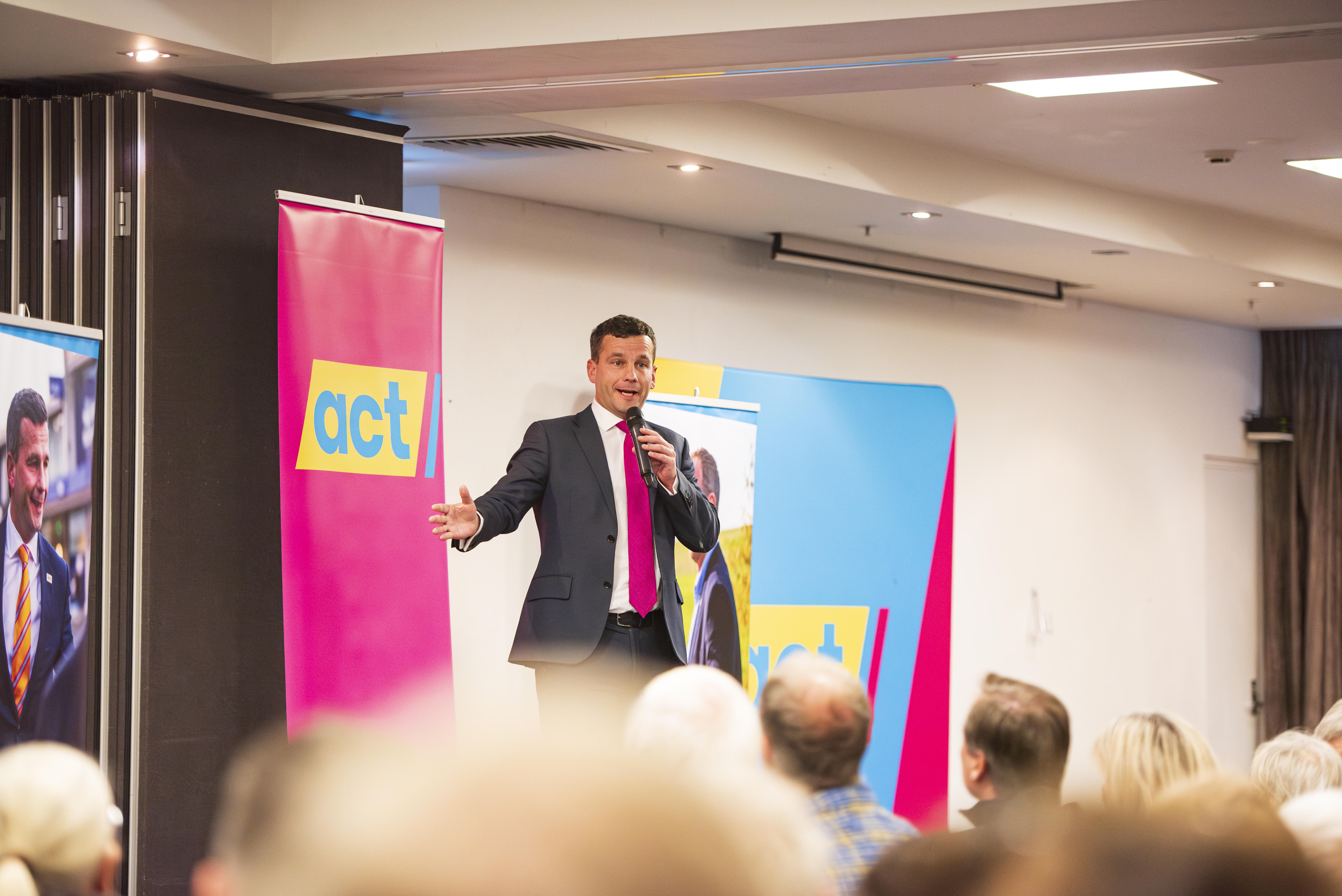
Speech to ANZ Christchurch: Young Investors - David Seymour

Speech to ANZ Christchurch, Thursday 23rd April David Seymour, ACT Leader

大卫·西莫尔

Introduction

Thank you, it’s a pleasure to be here. Thank you for what you do, as one Cantab once said to me, building world-beating businesses from the Canterbury Plains.

Some people think business is easy, so business success isn’t earned. They conclude it’s more moral just to take it than let you keep unearned wealth.

People who have that view suffer from a terrible condition called observer bias. Business success is often public, failure is usually private, so these people haven’t observed the full picture.

I grew up in an extended family of electrical contractors. My Grandfather talked endlessly about labour disputes, copper prices (for cables), the exchange rate, and every other unexpected challenge that makes business life an adventure of ups and downs. I feel lucky to have had that perspective.

I don’t believe that business is well understood, too often it’s made a scapegoat in our politics. That is bad for our prosperity as a country. Too often, political itches are scratched by blaming some business or sector for their alleged sorcery.

In reality, business combines four types of people who achieve together what they couldn’t do alone.

Investors want to earn a return on savings they have made by giving up today so they can have more tomorrow.

Workers want to exchange their time and talents for money, that they can use to invest themselves, or to be customers.

Customers exchange their money for a range of goods and services no person could produce themselves alone.

Entrepreneurs dream. Then they bring the investors, workers and customers together, to make their dreams reality.

Bringing those four types of people together is a beautiful form of human cooperation that we don’t celebrate enough.

Few of us will be entrepreneurs. All of us are customers, and most of us are workers for at least part of our lives. It’s the investor part that I’d like to talk about tonight.

New Zealand’s Productivity and Investment Challenge

This event is hosted by a bank. When you spend your working life around capital, markets, and long-term decision-making, you appreciate that societies succeed when more people have a stake in them.

It changes how people think about effort, risk, reward, and the future. Investment matters because that is how wealth is built, by people making decisions, taking responsibility, and backing enterprise.

For most New Zealanders their first and most prominent brush with investment is Kiwisaver. Most join via automatic enrolment when they get their first job after leaving school, their accounts accumulate over time and for many they won’t even look at it again until it’s time to buy their first home.

When you remove Kiwisaver from the equation, we have relatively low ownership and investment though. Sharesies is the biggest platform in New Zealand with about 550,000 Kiwis on their platform, just above one tenth of the adult population.

Many serious problems that almost everyone agrees we have stem from this low engagement in business investment.

The number one political issue today is the cost of living. The fuel shortage has boosted that concern, but it was still number one before the Middle East conflict began. However the issue can been seen another way. The prices alone are not the problem. The real problem is that wages have not kept up because productivity is too low.

We have too much of our wealth in housing compared with equity in productive business. Productivity growth has been flat for nearly two decades, asset price growth, especially in property, is the main way people have gotten ahead.

This dynamic is creating frustration and division. Every asset sale has two parties. Rising prices are great for the owner, but those young people who need to buy assets to live a good life see their future getting further away.

Too many of them see it as far away as another country. The ongoing export of people is another problem most people can agree on.

If we are going to become a wealthier and more unified country, without crashing existing asset prices, then we need growth. We need more investment in productive assets. That is challenging so long as business is poorly understood and often scapegoated.

The challenge of financial literacy

To change course, we need a boost in financial literacy. Too many young New Zealanders leave school without even a basic understanding of how wealth is created, how capital grows, or how businesses generate value.

Changing that requires a change in how the next generation thinks about business and investment. Bluntly, I do not think our current education system is set up to teach this.

If you are a teacher, your pay is negotiated collectively by a union, your resources are provided by the taxpayer, and if you lose customers, there is no commercial penalty.

This isn’t a criticism of teachers, but an acknowledgement that the education system is not commercial. It is not a natural environment to teach about markets, investment, and competition.

It’s also worth acknowledging that it’s not all doom and gloom. There is hope. Young people ARE interested in investing. I mentioned the 550,000 Kiwis in Sharesies. Any University Commerce department will have an investment club. Entrepreneurs like Elon Musk have a cult following online. The question is how we kindle that idea.

A new idea

If we are going to change our course as a country, we need new ideas, and we need to pass them to the next generation. Tonight I’d like to float a new idea. It is not an ACT policy yet, but it’s something I think is worth airing, to hear your feedback, and seek suggestions for improvement.

It goes like this. Every fifth former, or year 11 if you’re under 40, is given $500 in a controlled investment account, with a structured pathway into real investing.

That process could be supported by platforms such as Sharesies or BlackBull, with appropriate safeguards and curriculum support. But the key is that this would not be abstract theory, students would have skin in the game.

Over the year they graduate to higher levels of risk and reward, so long as they pass tests of their knowledge. If they don’t pass, they stay at lower levels.

In term one, they choose a term deposit. A safe investment, but one that introduces the basic idea of storing capital so it can be used by someone else to produce, earning a return for the investor.

In term two, they invest in a managed fund. This introduces the idea of risk. There are different levels of risk, depending on the underlying assets the fund invests in.

In term three, they can invest in New Zealand equities. This introduces the idea of companies. What do they sell? What are their costs? Who manages them and what is their future?

In term four, they are able to invest in assets from around the world. It’s a jungle out there. Exchange rates suddenly matter. The wider world has greater opportunity, but it is also more complex, and risky. There is a world beyond our coastline that is essential to understand.

Suddenly, they would want to know things like why is one company worth more than another? What makes a business grow? What makes it shrink? Why do future earnings matter? What is the net present value of an income stream? What the hell is ‘net present value?’

These are important ideas, but too many people do not encounter them until well after school, sometimes not until after university. Many people go their entire lives without encountering them at all, the Green Party’s electoral prospects rely on this.

We should be teaching young people how wealth is actually created. Business is the beautiful human synergy of investors, entrepreneurs, workers, and customers coming together to meet one another’s needs.

This policy would change how many people see the world. If you are an investor, even in a small way, you stop seeing yourself as a passenger in the global economy and start seeing yourself as someone who can take the wheel.

Paying for it

You’re probably surprised to hear the ACT Party wanting to give teenagers $500. The good news is this idea is affordable. It’s also not a handout, but an investment in young Kiwis to grow their own wealth. In the long run, it will get our country out of its financial funk more powerfully than any policy of remotely comparable cost.

It could be funded out of the roughly $600 million KiwiSaver annual subsidy. There are around 60,000 students in any cohort. $500 each is $30 million. Just five per cent of the annual subsidy could fund a $500 starting investment for every fifth-form student in New Zealand.

In other words, for a relatively modest amount of money, we could give a generation a practical introduction to saving, investing, ownership, and financial responsibility.

That way, the programme would not just transfer money. It would build capability. It won’t just be for the students. I predict more than a few parents will get interested in what their children are investing in.

Children whose parents already invest may have a head start, but those who don’t will benefit the most. Those on the political left should support this policy more than anyone.

The point of public education is to open up possibility to children who won’t get it at home. This policy would open up possibilities that children in poorer households almost by definition do not have.

The reward

Some people I’ve shared this idea with ask ‘why don’t you just use a simulator? You don’t need real money to do this!’ The simple reason is that skin in the game will motivate students. Schools won’t take it seriously unless students really want it, and with real money they’ll really want it.

Plus, they might keep the money. There are a few options.

It could be rolled directly into a student’s KiwiSaver as their first real contribution to long-term savings.

It could become a credit on their student loan account, tying into broader ideas about personal education accounts.

Or, to really sharpen incentives, you could allow students to keep any gains they make above the original $500, in cash. In that option, the principal is protected or transferred into KiwiSaver, but if they have invested wisely and grown the value, they get to keep the cash at the end of Term 4.

That would send a powerful message that good decisions have rewards.

And the opposite is true too. If you waste opportunities, there are consequences. That is a lesson far too many people are shielded from until adulthood, when the stakes are much higher.

Conclusion

New Zealand’s long term prosperity is going to remain under threat until we make staying here the obvious choice for every generation, not something young people have to weigh up against better wages and opportunity overseas.

This is just one idea that I think can help arrest the decline. A generation of savvy, financially literate young Kiwis will increase productivity more drastically than almost anything else.

And this cost-of-living crisis we’re in? It’s really a productivity slump. It is not just that inflation has driven up costs. It is that wages have not kept up with inflation. Real economic growth, after inflation, has gone backwards over the last five years.

The very good news is we can choose to fix it. Our country is small enough, we still care enough and we are resourceful enough to choose a different path.

Imagine the culture change. Instead of being taught to channel their economic frustration into blaming others’ success. We would be teaching young Kiwis to see themselves as owners, investors, participants, and decision-makers.

Instead of treating them as passive observers in the economy, we should equip them to become active creators of wealth.

Because a freer, more prosperous New Zealand will not be built by telling people to resent success. It will be achieved by having more people who believe in building success.

Thank you.

保持最新动态

注册我们的网站通讯

授权人:C Purves,套房 2.5,27 Gillies Avenue,Newmarket,奥克兰 1023。
©2025 ACT 新西兰。版权所有。

保持最新动态

注册我们的网站通讯

授权人:C Purves,套房 2.5,27 Gillies Avenue,Newmarket,奥克兰 1023。
©2025 ACT 新西兰。版权所有。

保持最新动态

注册我们的网站通讯

授权人:C Purves,套房 2.5,27 Gillies Avenue,Newmarket,奥克兰 1023。
©2025 ACT 新西兰。版权所有。